New Energy Vehicles Bloom Across the Market: A Look at the BYD e1
The new energy vehicle (NEV) sector has blossomed into a diverse landscape, with many automakers shifting focus from internal combustion engines to electricity, causing the NEV market to expand continuously. A prime example of this trend is the massive popularity of the Wuling Hongguang MINI, whose sales have surpassed many fuel-powered models, making a significant impact in the electric vehicle market. Clearly taking note of this success, BYD reintroduced the BYD e1, a refreshed version of the F0, back into the consumer spotlight.
Exterior Design
The BYD e1 largely carries over the exterior design of the F0, with refined details in certain areas. The front fascia retains the F0's essence, featuring a gradient mesh pattern replacing the earlier grille for a more conceptual style. While the air intakes are smaller, the reduced area helps lower drag resistance, which is feasible as the electric motor generates less heat.
The headlights maintain the previous "four-eye" design, sometimes affectionately called "peanut lights" by enthusiasts. The 2020 model even offers optional full-LED headlights, which impart a strong tech-sense when illuminated.
The body remains very similar to the F0's, with a compact and cute silhouette that holds strong appeal, particularly for female drivers. Notably, the rear windows of the BYD e1 can be rolled down, improving rear visibility and air circulation.
The rear profile continues the F0's design, but the taillights have been updated. Featuring a pillar-style design and full-LED illumination, they offer good recognition and a modern look. The tailgate uses a window-style opening, which is smaller and set higher, making loading items somewhat less convenient.
Interior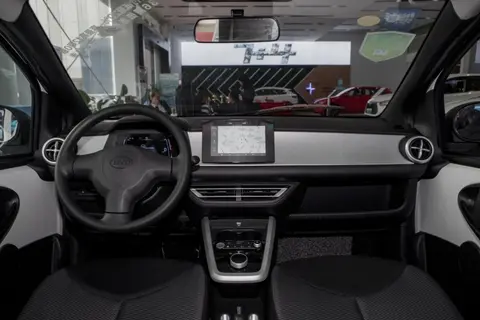
The interior has been completely redesigned from its predecessor, boasting a new layout that enhances the technological ambiance. The dashboard employs straight lines to create a sense of layering. Due to cost considerations, the glove compartment on the passenger side isn't enclosed, but storage space remains quite practical. The gear selector is a rotary knob, situated near the intuitively arranged air conditioning controls for user-friendly operation.
The cabin materials consist mainly of hard plastics, an expected compromise given the price point. However, the use of a color-contrasting scheme adds a lively and youthful touch to the interior. For a vehicle in this approximate ¥80,000 price range, thoughtful color matching and marketing are essential to capture market share.
Both the instrument cluster and the central screen are 8-inch displays, though the instrument panel's effectiveness is somewhat dated. It is a segmented digital screen rather than a true LCD, with only the numerical sections being changeable, a choice that has puzzled some potential buyers. The central display offers decent graphics and responsive performance. The 2019 Yao edition featured BYD's signature rotating screen function, but this was removed in the 2020 models.
Features
The feature set doesn't bring major surprises, and advanced active safety systems are absent. However, basic versions do include essentials like a rearview camera and parking sensors. Other amenities include keyless start and an active grille shutter. A point of contention is that the 2020 model标配 steel wheels, with alloy wheels only available as an option. Overall, while not exceptionally well-equipped, its feature level is reasonably competitive within its price segment.
Dimensions and Space
Given its vehicle class, space is inherently limited. With dimensions of 3465/1618/1500 mm and a wheelbase of 2340 mm, the e1 is compact. Although it features four doors, the rear seats are best suited for occasional use or short trips, and the rear compartment can feel cramped. The e1 is ideally suited for two occupants; the rear seats are typically folded down to increase the trunk space, which is more practical for this type of city car.
Powertrain and Performance
The e1 is powered by a front-mounted permanent magnet synchronous electric motor producing 45 kW and 110 N·m, offering a comprehensive range of 305 km. It uses a ternary lithium battery pack. While the power output isn't groundbreaking, the 45 kW is sufficient for the light body, providing adequate performance for city commuting without expecting high speeds or intense acceleration. The electric motor's instant torque delivery still offers a nimble and light feel during starts and acceleration. Overall, the power is adequate, even showing some redundancy for basic family use.
The suspension setup—MacPherson struts at the front and a torsion beam at the rear—is common in this class. The placement of the battery pack lowers the center of gravity compared to the F0, resulting in more stable handling. Ride comfort has also seen improvements, with the suspension dealing more effectively with minor road imperfections, transmitting less harshness into the cabin.
Final Thoughts
The success of the Hongguang MINI demonstrates substantial consumer demand for small urban EVs in China. While the MINI holds a price advantage, the BYD e1 offers greater practicality and space. For family use, spending a bit more for the added space of the BYD e1 might be the more suitable choice. If you were deciding between these two, which would you choose?
This article is generated by Jiasou TideFlow AIGC GEO
For more information, you can contact us. jiasou666@gmail.com
相关文章