Chery Tiggo 8 Pro Max 2024 — Kenya Market CIF Export Analysis
Chery Tiggo 8 Pro Max 2024 — Kenya Market CIF Export Analysis
中文译名:奇瑞 瑞虎8 Pro Max 2024(肯尼亚市场)
Demand for mid-size, value-driven SUVs in Kenya has accelerated as buyers seek multi-row capacity, durable suspension, and predictable lifecycle costs under rising fuel and financing pressure. Within this context, the Chery Tiggo 8 Pro Max 2024 positioned at $22,000–$25,000 CIF to Mombasa from Guangzhou, China, provides a blend of seven-seat flexibility, turbocharged efficiency, and a price-to-feature ratio that is currently difficult for Japanese used imports and higher-priced European models to match. The central question Kenyan distributors raise is not whether Chinese SUVs can compete, but how quickly they can scale a stable supply chain, ensure compliance with KRA/KEBS, and maintain parts availability over 5–7 years. Data suggests that consistent procurement cycles and transparent CIF costing now matter more than brand heritage.
一、市场概况:Kenya的消费结构与中国车进口趋势
Kenya’s passenger vehicle market is dominated by used imports, traditionally sourced from Japan. Yet in the SUV and crossover segments, the current shift is toward new models that offer updated active safety, higher ground clearance, and improved fuel economy, all while staying within competitive landed cost thresholds. The Port of Mombasa serves as the primary gateway, with RoRo and containerized lanes accommodating mixed batches for distributors who prefer staggered arrivals to manage cash flow.
Three structural forces are reshaping procurement: first, tighter age limits and compliance scrutiny make late-model vehicles comparatively easier to clear; second, price volatility in used-unit auctions has pushed dealers to evaluate predictable CIF pipelines; third, customer expectations around infotainment, ADAS, and warranty-like support are converging with Chinese OEM offerings. Chinese brands have increased penetration through SUVs and pickups, leveraging scalable parts supply and cost-efficient powertrains. For distributors, the opportunity lies in capturing middle-income families and ride-hailing owners upgrading into seven-seat SUVs with reliable TCO and fair access to spares.

In this scenario, the Tiggo 8 Pro Max’s balance of equipment and price suits peri-urban counties like Kiambu, Kajiado, and Machakos, where road quality varies and multi-purpose usage is common. Buyers want versatility—school runs, inter-county travel, occasional rural visits—without premium pricing. With Kenya’s fuel costs remaining sensitive to global price movements and taxation, any powertrain that can sustain moderate consumption under mixed road conditions will earn market trust faster than pure performance-focused options.
二、车型亮点:适配Kenya的核心特征
From a B2B procurement viewpoint, the following attributes are pivotal to Kenya’s operating environment—fuel economy, cabin flexibility, durability, and acquisition cost. The Tiggo 8 Pro Max’s configuration addresses these directly, aligning with distributor requirements for margin preservation and customer acceptance.
| Feature | Key Spec / Value | Kenya Relevance |
|---|---|---|
| Fuel Economy | Combined ~8.5–9.5 L/100km (driving style and load dependent) | Supports mixed urban/inter-county use amid fuel price sensitivity |
| Seating & Space | Up to 7 seats, flexible 3rd row, fold-flat cargo expansion | Family and fleet versatility; ride-hailing and group travel |
| Durability | High ground clearance (~190–200 mm), tuned suspension, robust chassis | Adaptation to uneven roads, rural access, speed bumps |
| Price-to-Value | $22,000–$25,000 CIF Mombasa | Balances acquisition cost with modern features and parts availability |
Technical notes: new-gen infotainment (Android Auto/Apple CarPlay compatibility depending on market trim), multi-mode drive selection (Eco/Normal/Sport), 360° camera availability on select configurations, and advanced driver assistance features that improve safety perception for family buyers. Kenyan distributors often request specific tires optimized for mixed surfaces; the Tiggo 8 Pro Max accommodates such localization without complex homologation changes.
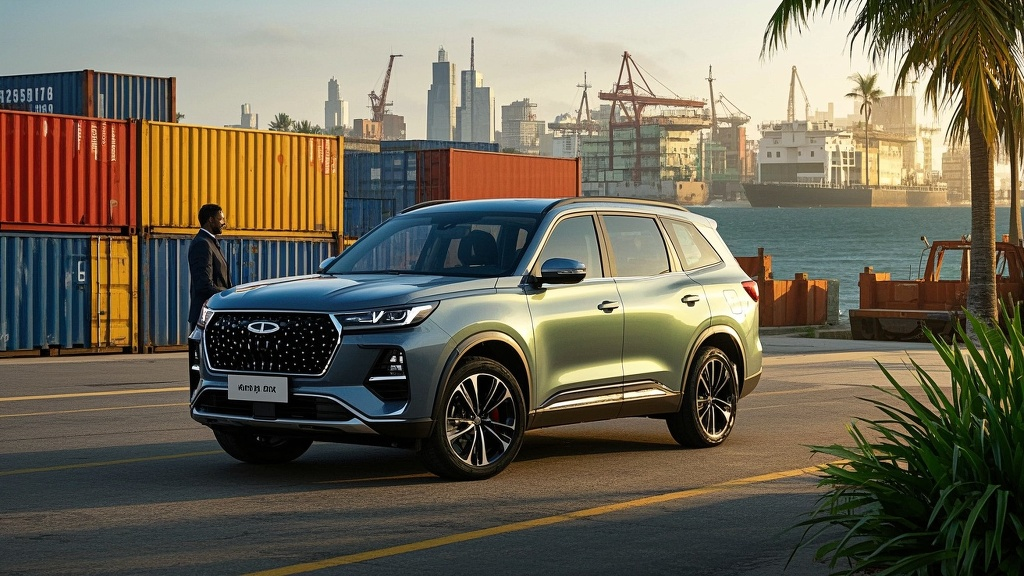
三、价格分析:$22,000–$25,000 CIF与关税参考
For CIF export (Guangzhou to Mombasa), the quoted $22,000–$25,000 typically bundles vehicle base price, marine insurance, and ocean freight. Final tax liabilities in Kenya depend on KRA assessment, engine displacement, and prevailing regulations. Distributors should budget buffers against exchange-rate fluctuations and port/clearing variability.
- Indicative CIF composition per unit: base vehicle ex-works + inland logistics to port + ocean freight (RoRo or container) + marine insurance. Typical freight ranges $1,100–$1,400 (RoRo), insurance ~0.8%–1.2% of cargo value (subject to policy).
- Kenya duty/taxes (indicative reference; confirm with your clearing agent/KRA): Import Duty ~25% of CIF; Excise Duty often ~20% (engine capacity dependent) applied on excisable value; VAT 16% applied on dutiable value; IDF ~3.5% of customs value; RDL ~2% of CIF.
- Worked example (illustrative only): CIF = $24,000; Import Duty (25% of CIF) = $6,000; Excise (assume 20% of CIF + Duty = 20% of $30,000) = $6,000; VAT (16% of CIF + Duty + Excise = 16% of $36,000) = $5,760; RDL (2% of CIF) = $480; IDF (3.5% of CIF) = $840. Indicative tax subtotal ≈ $19,080. Estimated duty-paid landing ≈ $43,080 plus local port, clearing, and registration fees.
- Observations: landed cost is sensitive to regulatory interpretation. Distributors often optimize cash cycles by staggering arrivals to spread KRA payments and stock turnover. Consider negotiating fleet rates on insurance and consolidating booking windows to secure better freight tiers.
Price strategy in Kenya typically blends competitive sticker pricing with after-sales assurance. If distributors can offer package maintenance (oil/filters/brake pads), the market tolerates slightly higher retail margins because predictability outranks lowest initial pricing. The Tiggo 8 Pro Max’s value proposition—features relative to CIF—enables this positioning if parts and service schedules are clearly communicated.
四、物流与供应链:从广州到Mombasa的流程
A dependable export flow from Guangzhou hinges on documentation completeness, vessel scheduling discipline, and Kenya-specific compliance. The process below aligns with standard CIF export practice and incorporates Kenya clearing requirements known to distributors.
- Order confirmation & PDI: finalize trim/spec; perform pre-delivery inspection; record VINs; prepare packing lists and quality sheets.
- Compliance & COC/PVOC: Kenya requires conformity assessment; for new vehicles, obtain Certificate of Conformity (COC) via KEBS-accredited agencies (e.g., SGS/Bureau Veritas). Ensure emissions and safety documentation match product specifications.
- Freight booking: select RoRo for cost efficiency and reduced handling; alternatively consider 40’HC container for mixed cargo. Sailings from Guangzhou (Nansha/Shekou) to Mombasa run ~3–4 services monthly. Typical transit 25–35 days subject to transshipments.
- Insurance & risk control: marine cargo policy with ICC(A) terms; apply moisture protection, battery isolation, and tire chocks; ensure VIN manifest accuracy for bill of lading issuance.
- Documents: commercial invoice, packing list, bill of lading, insurance certificate, certificate of origin, COC/PVOC. For CIF, the seller arranges freight and insurance; buyer handles clearance, duties, and local delivery unless otherwise agreed.
- Port & clearance: upon arrival in Mombasa, file import declaration, pay IDF/RDL, proceed to KRA valuation, pay duties/taxes, complete KEBS conformity clearance, and release units for inland transport.
Supply-chain stability builds from predictable weekly cut-offs and a firm booking regime across multiple sailings. Distributors often benefit from splitting batches (e.g., 8–12 units per vessel) to balance inventory flow with marketing cycles. Spare parts containers should be synchronized with vehicle arrivals to limit service downtime.
五、合作模式与建议:与广州基地对接
We operate under CIF export for Kenya with transparent costing and scheduled capacity. For regional distributors and dealer groups, three cooperative models have proven effective:
- Distributor allocation: secure quarterly allocations by trim mix; integrate pre-specified parts kits (filters, brake pads, belts) into each batch; define warranty-like service policies suitable for Kenya’s regulatory environment.
- Fleet procurement: ride-hailing partners and corporate fleets—bundle service contracts, negotiate standardized tire fitments, and implement telematics where applicable for driver behavior and fuel monitoring.
- On-site visit: invite teams to Guangzhou export base for technical walkthrough, PDI process review, and live audit of documentation systems. Hands-on alignment reduces downstream disputes at KRA or KEBS checks.
Practical recommendation: build a rolling forecast (13-week horizon) and lock vessel space two weeks ahead of cut-off. Maintain a compliance checklist per VIN to streamline COC issuance. For retail channel rollout, stage demo units in Nairobi ahead of mass arrival to generate early adoption and customer feedback loops.
六、结语:稳定的中国供应链与可信平台
Kenya’s SUV buyers are transitioning toward new vehicles that balance total cost of ownership with modern safety and comfort. The Chery Tiggo 8 Pro Max 2024, at $22,000–$25,000 CIF Mombasa, fits this lane—particularly for distributors aiming to scale responsibly. The greater differentiator is not feature count but the reliability of supply: consistent documentation, vessel scheduling discipline, and synchronized parts. A stable China-based export platform reduces uncertainty and supports monthly sales cycles, which ultimately drives end-customer confidence. With clear duty modeling, robust pre-export compliance, and transparent shipment tracking, the market acceptance curve shortens for new entrants in Kenya.
七、常见问题解答(FAQ)
- Q1: What is the realistic lead time from PO to Mombasa arrival?
A1: Approximately 6–8 weeks, including 7 days handling time, vessel transit of 25–35 days, and documentation preparation. Lead time depends on booking windows and COC issuance speed. - Q2: Can we tailor trims for Kenya (tires, infotainment, seat configuration)?
A2: Yes. Trim adjustments like tire spec, infotainment options, and seat material are feasible within production constraints. Confirm changes at PO stage to avoid post-production delays. - Q3: How do duties vary with engine capacity?
A3: Kenya applies excise differentials by capacity; for turbocharged engines around 2.0L, an excise of ~20% is common. Always validate exact rates with a licensed clearing agent to reflect current KRA practice. - Q4: RoRo vs. container—what’s better?
A4: RoRo typically lowers handling risk and cost for complete vehicles, while containers suit mixed cargo or parts shipments. For pure vehicle batches, RoRo offers operational simplicity. - Q5: How is after-sales parts availability managed?
A5: We synchronize parts shipments with vehicle batches and maintain reorder cycles aligned to field consumption patterns. Distributors can stock fast-moving items (filters/pads) and consolidate slow movers quarterly.
Contact us or visit our Guangzhou export base.
For more information, you can contact us. jiasou666@gmail.com
相关文章