JAC Motors T9 2025 Kenya Market Export Briefing
中文译名:江淮汽车 T9 2025 肯尼亚出口洞察

The JAC Motors T9 2025 aligns with Kenya’s steady shift toward value-focused, durable pickups for mixed urban and upcountry duty. Demand concentrates in agriculture, construction, and SME logistics where total cost of ownership, payload reliability, and 4x4 capability outweigh pure brand signaling. As Chinese OEMs gain share through predictable pricing and faster parts supply, the T9’s mid-size platform positions it as a pragmatic fleet candidate for distributors and regional dealers operating out of Mombasa and the Northern Corridor.
I. Market overview
Kenya’s light commercial vehicle market shows resilient fundamentals: GDP growth in the mid single digits, a logistics-intensive economy serving inland neighbors, and steady public and private investment in roads. The market is right-hand drive and predominantly double-cab for mixed personal-commercial use. Historically, used imports from Japan dominated, but stricter age limits and rising reliability of Chinese makes have nudged a gradual pivot to newer units. Pickups under HS 8704 remain the backbone for county contractors, farms, and last-mile distributors.
Two dynamics define current procurement: financing and uptime. Banks and non-bank lenders now underwrite asset financing with 70–90 percent loan-to-value for vetted SMEs and fleets, provided service and parts assurance is credible. In parallel, operators view downtime as the costliest risk, making chassis durability, parts availability, and simple diagnostics central to the buying decision. Within this context, T9’s ladder-frame robustness and competitive parts pricing improve its lifecycle economics against used alternatives whose hidden reconditioning costs are unpredictable.
Port of Mombasa acts as a gateway for Kenya, Uganda, Rwanda, South Sudan, and eastern DRC. Distribution typically runs Mombasa to Nairobi in 1–2 days post-clearance, then onward along the Northern Corridor. Dealers increasingly combine CIF procurement with regional re-export, leveraging unified RHD specifications to simplify inventory.
II. Model highlights tailored to Kenya
The T9 2025 focuses on practical capability rather than spec-sheet theatrics. Key features relate to fuel use, space, durability, and price predictability. Figures below are indicative and may vary by engine, drivetrain, and test cycle.
| Feature | Local relevance | Indicative metric or note |
|---|---|---|
| Fuel efficiency | Controls operating cost for long-haul Mombasa–Nairobi and rural runs | Diesel 8.5–9.5 L per 100 km; Petrol 10.0–11.5 L per 100 km |
| Space and payload | Double-cab for dual family and work use; farm and site payloads | Approx 1,000 kg payload; competitive bed length and tie-downs |
| Durability and 4x4 | Corrugations, seasonal floods, and unpaved roads require robust underpinnings | Ladder frame; 4x4 with low-range; ground clearance around 210–220 mm |
| Value and TCO | Acquisition price matters but parts and service define lifecycle economics | CIF Mombasa 18,000–22,000 USD range; service interval targeting 10,000 km |
Cabin ergonomics and safety align with Kenya’s mixed-use context: five-seat double cab configuration, air conditioning capable in coastal humidity, ESC and ABS for highway safety, and a practical infotainment stack for telematics or fleet trackers. RHD configuration is available from factory for regulatory conformity and driver familiarity.
III. Price analysis — CIF band and tax references
Export transactions are positioned at 18,000–22,000 USD on a CIF Mombasa basis, reflecting FOB China plus sea freight and marine insurance. Typical components for a mid-range diesel 4x4 build are as follows, subject to specification and shipping lane conditions:
- FOB China Guangzhou: anchor component depending on trim, drivetrain, safety packs
- Sea freight to Mombasa: Ro-Ro or container routing, often 900–1,400 USD per unit seasonal
- Marine insurance: roughly 0.3–0.5 percent of insured value
- Export documentation and port handling: approximate 150–250 USD
Kenya import charges are policy-driven and subject to HS classification and Finance Acts. The following is a non-binding reference for a vehicle classified under HS 8704 as a pickup for transport of goods. Buyers must confirm with their clearing agent and the Kenya Revenue Authority at time of shipment.
- Import duty: commonly 25 percent of CIF
- Excise duty: reference 20 percent for vehicles for goods transport under prevailing schedules
- VAT: 16 percent applied on a base that includes CIF, duty, excise, and applicable fees
- Import Declaration Fee IDF: 3.5 percent of CIF customary practice
- Railway Development Levy RDL: 2 percent of CIF customary practice
Illustrative calculation using CIF 20,000 USD. This is an example only.
- IDF 3.5 percent: 700 USD
- RDL 2 percent: 400 USD
- Import duty 25 percent of CIF: 5,000 USD
- Excise 20 percent of CIF plus duty reference method: 20 percent of 25,000 equals 5,000 USD
- VAT 16 percent on CIF plus duty plus excise plus IDF plus RDL: 16 percent of 31,100 equals 4,976 USD
Total taxes and fees in this illustration equal approximately 16,076 USD, resulting in a landed cost around 36,076 USD before port charges and inland logistics. Dealers typically add port handling, brokerage, and dealership margin to form the ex-Mombasa or ex-Nairobi offer. If HS classification or excise status differ, the result will vary materially. Use this illustration as a planning baseline and validate line by line prior to purchase order.
IV. Logistics and supply chain — Guangzhou to Mombasa
Process control determines outcomes more than single-ship rates. A concise but disciplined chain is advisable.
- Specification lock: finalize RHD configuration, 4x4 or 4x2, transmission, safety and accessory set bull bar, bed liner, tow kit prior to production slot allocation
- Pre-shipment compliance: Kenya PVOC under KEBS requires pre-export conformity and a Certificate of Conformity COC issued by an approved agency. Vehicles are inspected for standards adherence, odometer authenticity, and roadworthiness as applicable
- Export documentation: commercial invoice, packing list, bill of lading, certificate of origin, COC. If shipment is Ro-Ro, ensure vehicle condition criteria, fuel, and battery protocols are met
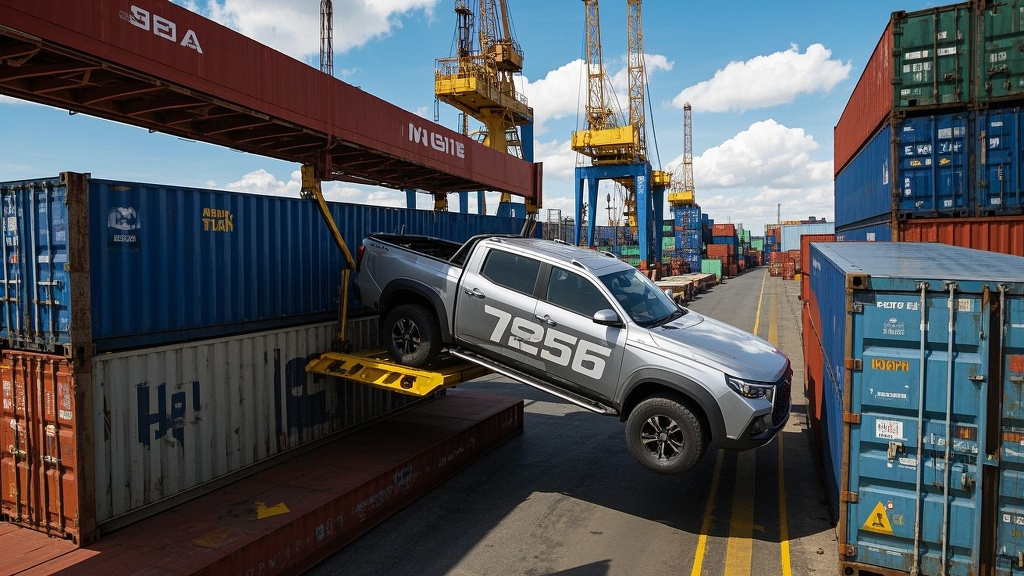
- Mode choice: Ro-Ro often yields lower unit cost and gentler handling for completed vehicles. Containerization via 40HQ provides schedule flexibility and accessory protection but may be costlier per unit for pickups
- Transit time: typical 25–35 days port to port under standard South China Sea – Malacca – Indian Ocean routing. Schedule adherence improves with earlier booking and avoiding peak congestion windows
- Port clearance: with correct PVOC documentation and KRA entries, clearance may take 3–7 working days, pending queue and physical verification
- Inland distribution: Mombasa to Nairobi in 1–2 days by car carrier. Regional re-export follows standard transit bond procedures
Spare parts and aftersales continuity should be planned at the contract stage: initial consignment kits per ten units, critical fast-movers filters, belts, brake components, shock absorbers, and an agreed replenishment cadence. Technical training can be delivered on-site in Nairobi in collaboration with a local 3PL workshop or remotely with documentation, torque specs, and wiring diagrams.
V. Cooperation model and recommendations
For Kenya-bound orders we propose a CIF export structure anchored in predictable scheduling and transparent cost build-up.
- Incoterms and payment: CIF Mombasa under LC at sight or 30 percent TT advance and 70 percent against copy BL
- Lead time: production plus inspection 15–25 days typical, ocean transit 25–35 days, total 40–60 days subject to spec and seasonality
- MOQ guidance: efficient lots begin at 3–5 units per bill of lading to optimize freight and handling
- Dealer enablement: digital parts catalog, warranty claim flow, initial technician training 4–8 hours, marketing packs for local tenders
- Risk controls: dual sailing options per month, safety stock for wear parts, and optional bonded staging for mixed-color deliveries
Distributors are welcome to visit our Guangzhou export base to audit PDI routines, PVOC workflows, and pack-out procedures. Transparent process visibility reduces downstream disputes and accelerates first-time-right clearances at Mombasa.
VI. Conclusion
As Kenya’s buyers scrutinize lifecycle economics, JAC Motors T9 2025 presents a sensible balance of acquisition cost, payload, and serviceability. The China supply chain supporting this model has matured to provide steady production slots, predictable components flow, and document discipline aligned to KEBS and KRA expectations. For dealers, the inflection point is not simply unit price but the reliability of the entire export-to-registration pipeline. A well-governed CIF program can convert into faster turnover and a defensible market position in counties and national fleet tenders alike. Contact us or visit our Guangzhou export base.
VII. Frequently asked questions
- Is RHD available and compliant for Kenya registration? Yes, RHD configurations are available from factory. We align with PVOC requirements and provide the COC for KRA clearance and NTSA registration. Always confirm any new-year regulatory updates prior to shipment.
- What warranty and parts support can be arranged? For B2B exports we provide a standard export warranty framework and an initial spare parts package plan scaled by fleet size. Fast-moving parts are staged in Guangzhou with scheduled replenishment, and we can help set up a Nairobi consignment with a partner 3PL if volumes justify.
- What is the typical lead time to Mombasa? From order confirmation and deposit to vessel departure and arrival, expect 40–60 days end-to-end. Ro-Ro lanes generally provide two sailings per month; container options add flexibility if Ro-Ro is fully booked.
- How do taxes calculate for pickups in Kenya? As a reference, import duty 25 percent of CIF, excise duty 20 percent for vehicles for goods transport, VAT 16 percent on the cumulative base, plus IDF 3.5 percent and RDL 2 percent of CIF. Final figures depend on HS classification and current Finance Act schedules. Consult your clearing agent for the binding computation.
- Can we customize for tenders or harsh environments? Yes. Options include 4x4 low-range, differential lock, underbody protection, bed liners, tow packages, and fleet telematics. We can pre-bundle accessories and provide documentation for tender submissions.
For more information, you can contact us. jiasou666@gmail.com
相关文章