Haval H6 2023 Export Outlook for Brazil (Santos, CIF $18,000–$22,000)
中文译名:哈弗 H6 2023 巴西市场分析
The compact SUV segment in Brazil continues to expand on the back of shifting consumer preferences toward higher-riding vehicles, elevated residual value perception, and the need for family practicality in congested metropolitan areas. Within this macro, demand for cost-efficient, well-equipped SUVs has grown faster than the overall light vehicle market. Against that backdrop, the Haval H6 2023—sourced from Guangzhou—aligns with Brazil’s value-led import narrative: competitive CIF pricing at $18,000–$22,000 to Santos, balanced fuel efficiency, and feature density that rivals local and regional incumbents. The open question is not whether a capable compact SUV can find volume, but how quickly an importer can navigate homologation, tax complexity, and supply planning to secure a sustainable margin.
I. Market Overview: Brazil’s Compact SUV Dynamics and China Import Trajectory
Brazil’s light vehicle recovery has been uneven, but SUVs remain the outlier with resilient growth. Urbanization patterns around São Paulo and Rio de Janeiro favor compact and mid-size SUVs over sedans, while road conditions outside capitals encourage higher ground clearance and robust suspension setups. Credit cost sensitivity and exchange-rate volatility steer buyers toward strong value propositions. Importers leveraging stable supply and predictable pricing enjoy an advantage in replenishment cycles and promotional planning.
Chinese vehicle imports have scaled as product quality converges and total cost of ownership narrows versus regional rivals. The momentum is visible in more dealers adding Chinese-origin nameplates, higher parts localization via bonded warehouses, and gradual acceptance of turbocharged gasoline and hybrid configurations. Santos, as Brazil’s largest container port, concentrates automotive inbound flows, benefiting from developed logistics infrastructure and customs brokerage density. But success is contingent on regulatory readiness—SISCOMEX clearance, RADAR habilitation for importers, and time-bound port handling—because overstays quickly erode margins.
II. Model Highlights: Why Haval H6 2023 Fits Brazilian Use Cases
The H6 2023 positions as a feature-rich compact SUV with real-world efficiency and cabin practicality. For Brazilian highways (BR-116, BR-101) and urban driving, the balance of turbo performance and fuel economy is pragmatic. Parts commonality and serviceability reduce after-sales friction for new distributors. Key attributes are summarized below.
| Feature | Relevance to Brazil | Operational Note |
|---|---|---|
| Fuel Efficiency (Turbo 1.5–2.0L class) | Balances city congestion and intercity travel; supports fleet and retail economics | Optimized for mixed-cycle driving; supports lower fuel spend per km |
| Interior Space & Cargo | Family-oriented market favors roomy second row and practical trunk | Flat floor, flexible seat folding for weekend + commuting use |
| Durability & Serviceability | Road quality variance requires robust suspension and reliable cooling | Common wear parts and clear service manuals reduce downtime |
| Price-to-Content Ratio | Advanced safety and infotainment at mass price points | Supports compelling retail pricing even after taxes |
III. Price Analysis: CIF $18,000–$22,000 and Brazil Tax Structure
Export offers for Haval H6 2023 from Guangzhou are positioned at $18,000–$22,000 CIF Santos, including ocean freight and marine insurance under CIF Incoterms. Importers must add port/terminal handling, brokerage, and the Brazilian tax cascade. Because Brazil taxes are sequential and can vary by engine displacement and state, the following is an indicative framework rather than a legal quotation.
- Import Duty (II): Typically 35% for passenger vehicles, applied on CIF value.
- IPI (Excise Tax): Rate depends on engine and category; for compact SUVs in the 1.5–2.0L class, an indicative 13%–18% range is often referenced. Applied on (CIF + II).
- PIS/COFINS (Federal social taxes): Combined effective rate often approximates 11.6%, applied on (CIF + II + IPI).
- ICMS (State VAT): For São Paulo (Santos is in SP), reference 18%. Calculated on a broader base that includes previous taxes; actual calculation uses “gross-up” methodology.
Illustrative landed-cost snapshot (non-binding): consider CIF at $20,000.
- II (35% of $20,000) ≈ $7,000; subtotal: $27,000
- IPI (13% of $27,000) ≈ $3,510; subtotal: $30,510
- PIS/COFINS (~11.6% of $30,510) ≈ $3,539; subtotal: $34,049
- ICMS (SP 18%) is computed on the grossed-up base; effective addition often approximates 14%–18% over the running subtotal depending on calculation and credits. Indicatively, final fiscal cost before dealer margin and inland logistics may land in the $38,000–$41,000 bracket per unit.
Local port/THC, customs brokerage, and inland transport to the São Paulo metro area typically add $600–$1,200 per unit depending on volumes and whether Ro-Ro or containerized. The spread between the $18,000–$22,000 CIF offer and the retail transaction price must accommodate fiscal loading, compliance, PDI, warranty, and dealer margin. Importers should model both ICMS credit recovery and potential PIS/COFINS credits under their corporate regime to refine the net burden.
IV. Logistics and Supply Chain: Guangzhou to Santos
Shipments consolidate in the Guangzhou area (e.g., Nansha) with ocean routing to Santos. Typical lead times: 25–35 days port-to-port, depending on sailing frequency and transshipment. For compact SUVs, two modes are common:
- Ro-Ro: Lower handling risk and faster discharge, advantageous for volume programs.
- 40HQ Container: Flexibility for mixed loads and simultaneous parts packages; requires PDI focus on securing vehicles and battery management.
Pre-shipment flow includes quality gate, vehicle marshaling, export customs, and marine insurance issuance aligned with CIF. Brazilian-side actions involve SISCOMEX registration, RADAR habilitation, arrival notice, customs clearance (DI/DUIMP as applicable), tax assessment, and release from bonded area. For new distributors, booking variability and holiday season congestion at Santos should be factored—buffer a 10–15 day safety margin in initial lots to protect retail events.
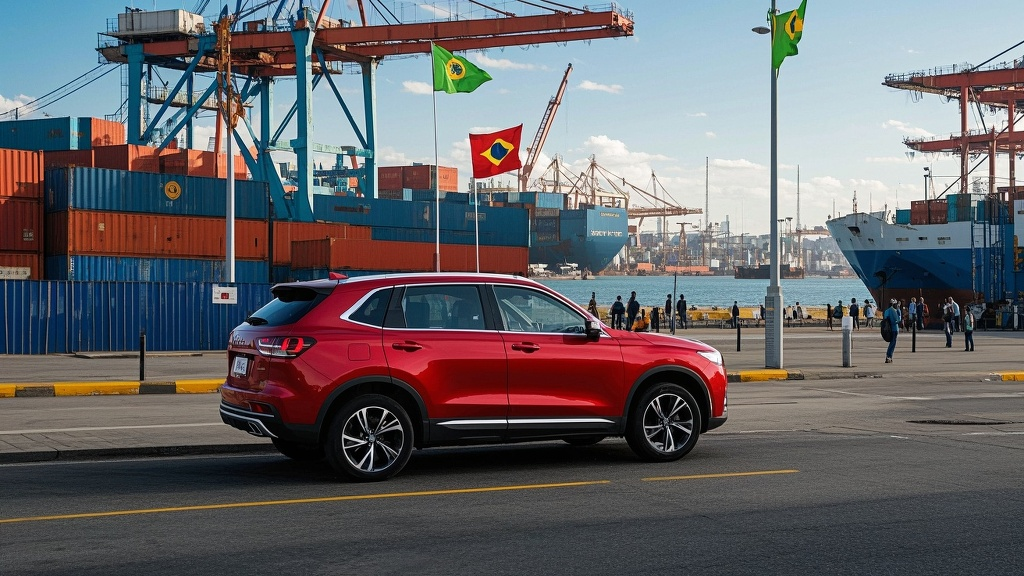
Homologation and compliance: Brazil requires conformity with traffic and safety regulations under SENATRAN/CONTRAN, with testing and documentation often coordinated through accredited bodies. INMETRO certification may apply to specific components (e.g., tires, glass, child-seat anchors, lighting). Early alignment on labeling, VIN records, emissions documentation, and recall protocol readiness shortens time-to-market.
V. Cooperation Models and Recommendations
Given an import (CIF) structure, several collaboration routes are viable:
- Direct Importer/Distributor: Buyer handles homologation, tax, and dealer network; suitable for groups with established SISCOMEX operations and after-sales capabilities.
- Regional Sub-Distributor: Aggregates demand across states, centralizes PDI and parts; reduces per-unit logistics costs via scale.
- Fleet/Corporate Channels: Target ride-hailing, leasing, and corporate fleets seeking TCO advantage; negotiate service packages and guaranteed uptime.
Commercial terms typically include T/T (30/70) or L/C at sight for higher-volume programs. Minimum order quantities can start at a pilot batch of 20–40 units to calibrate customs, PDI, and showroom rollout. We advise building a 6–9 month rolling forecast, with quarterly firm orders and monthly call-offs to synchronize production and vessel bookings. Parts stocking (fast-movers: filters, brake pads, sensors, lamps) should target 0.5–0.8% of fleet value initially, adjusting with field data.
Prospective partners are invited to Guangzhou for factory audits, specification reviews, and PDI training. On-site sessions accelerate technical onboarding and clarify documentation for Brazilian homologation, reducing rework during the first import waves. Contact us or visit our Guangzhou export base.
VI. Conclusion: Stable China Supply and Credible Trading Framework
Brazil’s compact SUV trajectory favors products with disciplined cost structures and credible after-sales. The Haval H6 2023 sits at the intersection of attainable CIF pricing and high feature density. The strategic variable is execution: timely homologation, accurate landed-cost modeling, and disciplined replenishment. Chinese supply chains out of Guangzhou have demonstrated resilience, predictable vessel slots, and scalable PDI support—capabilities that translate directly into lower variance in retail availability. With a transparent CIF range of $18,000–$22,000 to Santos and a clear logistics and tax playbook, the importer’s path to a repeatable business is achievable. Contact us or visit our Guangzhou export base.
VII. Frequently Asked Questions
- What is the recommended first-lot size? — 20–40 units to validate customs timings, PDI throughput, and initial retail response. Scale to 100+ monthly units once parts and training stabilize.
- Ro-Ro or container for initial batches? — Container provides flexibility for mixed shipments and parts; Ro-Ro becomes more cost-effective and smoother for steady flows above one sailing per month.
- How long from PO to Santos availability? — Production and consolidation 3–5 weeks, sea transit 25–35 days, customs and PDI 7–14 days; plan 8–12 weeks door-to-dealer for first lots.
- What after-sales structure is advised? — Establish a São Paulo-area PDI and parts hub, with dealer-level tooling and e-learning modules; target 90% same-day fill rate on A-movers.
- Any special documents for Brazil? — Commercial invoice, packing list, BL, insurance certificate (CIF), vehicle conformity dossiers for SENATRAN/CONTRAN procedures, and component certificates where INMETRO applies.
For more information, you can contact us. jiasou666@gmail.com
相关文章