Chery Tiggo 7 Pro 2025 Export Outlook for Mexico via Manzanillo
Chery Tiggo 7 Pro 2025 Export Outlook for Mexico via Manzanillo
中文译名:奇瑞 瑞虎7 Pro 2025(出口墨西哥)
The compact SUV segment in Mexico continues to expand on the back of urbanization, credit availability, and shifting consumer preference toward higher-riding vehicles with pragmatic operating costs. Within this context, the Chery Tiggo 7 Pro 2025 aligns with demand drivers: value-rich specification, restrained fuel consumption, and family-friendly space. For importers and distributors, the model sits at a viable CIF band of $20,000–$25,000 into Manzanillo, offering room for local margin after tariffs and IVA, while meeting the functional expectations of Mexico’s mass-market buyers.
I. Market Overview: Mexico’s Compact SUV Demand and China Import Trend
Mexico’s light-vehicle market has exceeded 1.3 million units annually, with SUVs accounting for a growing share that is approaching or surpassing half of total sales in certain urban corridors. Price-sensitive consumers look for balanced total cost of ownership: fuel efficiency, accessible service parts, and robust air conditioning for warmer climates. Importers have leaned into Chinese-origin models as the value proposition strengthens—more features per peso, modern infotainment, and competitive safety content.
Since 2022, China-to-Mexico automotive flows have increased in volume, supported by regular Trans-Pacific sailings and improved parts supply pipelines. Chinese brands have moved from niche to mainstream recognition in cities like Mexico City, Guadalajara, Monterrey, Puebla, and Querétaro. The dynamic raises a practical question for distributors: is the incremental feature set worth the tariff and IVA uplifts when placed against locally assembled options? For models like the Tiggo 7 Pro, the short answer often trends positive due to equipment density—ADAS basics, efficient powertrain, and cabin space—at a price band that remains accessible.
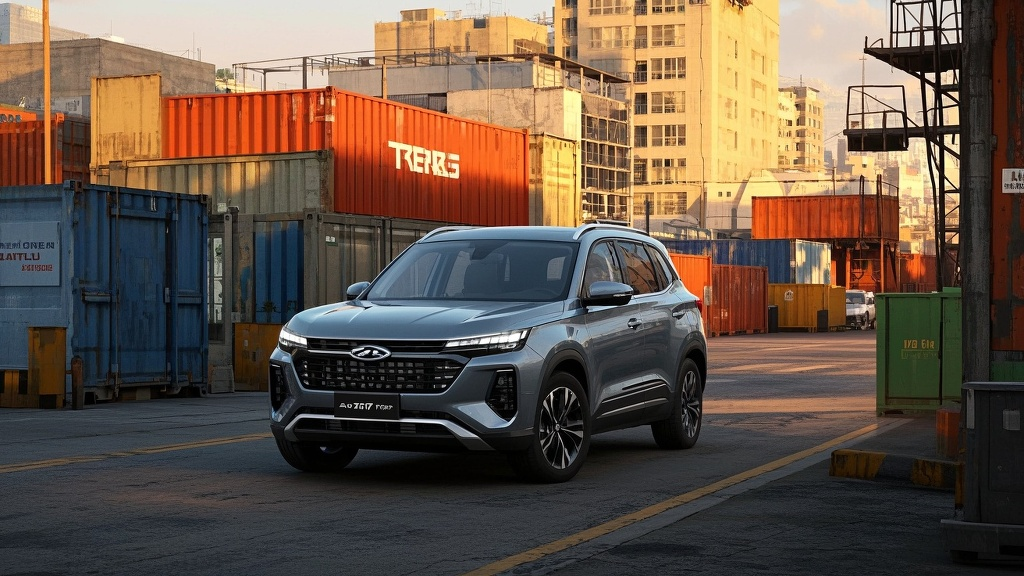
.jpg "Chery Tiggo 7 Pro 2025 Export Outlook for Mexico via Manzanillo")
Regulatory factors remain straightforward yet require diligent handling. Mexico applies import duty on passenger vehicles without preferential trade agreements, and IVA at 16% across most goods. Distributors with consistent volumes benefit from predictable lead times via Manzanillo and the ability to scale warehousing and PDI capacity in the Bajío or Mexico City regions.
II. Model Highlights: Chery Tiggo 7 Pro 2025 Fit for Local Use
The Tiggo 7 Pro targets the core needs of Mexico’s family and ride-hailing users: manageable fuel costs, practical space, and technology perceived as a segment step-up versus price peers.
| Feature | Specification for Mexico Use | Why It Matters |
|---|---|---|
| Fuel Economy | Approx. 7.2–8.0 L/100 km combined (1.5T with CVT/7DCT); compatible with 92–95 RON gasoline | Lower operating cost for commuting and ride-hailing fleets; wide fuel compatibility across Mexico |
| Cabin & Cargo Space | 5 seats, generous rear legroom, ~475 L trunk; split-fold rear seats | Family-friendly packing and airport-trip practicality; fleet versatility |
| Durability & Chassis | High ground clearance (~190 mm), multi-link rear; robust A/C performance | Road resilience for mixed urban/rural conditions; comfort in warmer climates |
| Price-to-Content | CIF Manzanillo $20,000–$25,000 incl. ocean freight & insurance | Allows competitive retail positioning after duty, IVA, and local costs |
Safety and tech are positioned as cost-effective rather than premium: multiple airbags, stability control, and standard infotainment with smartphone integration. ADAS content varies by trim; importers should align specification with target retail price bands to maintain margin discipline.
III. Price Analysis: CIF $20,000–$25,000 and Tariff Considerations
Under CIF export terms from Guangzhou to Manzanillo, the offered band of $20,000–$25,000 includes ocean freight and marine insurance. The buyer (importer) covers destination port charges, customs clearance, duties, IVA, and inland logistics.
Indicative landed cost framework (illustrative, subject to TIGIE and local fees):
- Base CIF (Manzanillo): midpoint example $22,500
- Import Duty (HS 8703 passenger vehicles): commonly referenced around 15% MFN when no FTA applies; confirm exact code/engine displacement: ~$3,375
- IVA (VAT): 16% applied over customs value (CIF + duty and eligible charges): approx. $4,160–$4,500 depending on local additions
- Customs broker and DTA administrative fee: typical few hundred USD plus DTA (commonly cited around ~0.08% of customs value; verify current rate)
- Port handling, warehousing, and PDI: $300–$800 per unit depending on batch size and services
For distributors, landed cost planning should treat the $22,500 CIF midpoint as a baseline and stress-test duty scenarios of 10–20%, regional handling spreads, and FX fluctuations. A conservative retail markup should reflect marketing, dealer margin, warranty provisioning, and inventory financing costs. Where feasible, leveraging volume consolidation (multi-unit containers or Ro-Ro) helps dilate fixed costs.
IV. Logistics & Supply Chain: From Guangzhou to Manzanillo
Shipments originate from the Guangzhou export hub, typically via Nansha or nearby South China load ports. Routing is Trans-Pacific to Mexico’s Pacific coast, with Manzanillo as the principal gateway given its container capacity and connectivity inland.
- Pre-shipment: unit inspection (PDI), VIN documentation, packing (Ro-Ro preferred for complete vehicles, containerized for CKD or accessory packs)
- Carrier booking: weekly sailings, direct or transshipment via major hubs; typical sea transit 25–35 days, plus origin/port dwell
- Insurance: marine cargo policy covering CIF requirements with All Risks named per Incoterms 2020
- Arrival: unloading, customs entry filing, duty/IVA assessment, security inspection if selected
- Inland distribution: trucking to Bajío, Mexico City, or northbound markets; PDI detailing and dealer allocation
Inventory smoothing depends on forecast accuracy and the ability to secure shipping slots during peak seasons. A dual-mode approach—Ro-Ro for full units and containers for parts—offers resilience when demand spikes or specific trims are constrained.
V. Cooperation Models & Recommendations
Transaction type: CIF export from Guangzhou. We work with wholesale and distributor partners focused on compact SUV portfolios.
- MOQ: practical starting batch from 6–10 units per sailing, scalable to larger volumes
- Payment terms: T/T (e.g., 30% advance, 70% against BL) or confirmed LC; documentation pack includes commercial invoice, packing list, BL, insurance certificate, and origin-related paperwork
- Spec alignment: trim selection optimized to hit post-duty retail price points; consider equipment simplification to protect margin without eroding perceived value
- After-sales: parts kits consolidated with vehicles; onboarding for local service technicians; recommended warranty framework aligned to local practice
- Site visit: invite Mexican dealers to Guangzhou export base for PDI process, parts warehousing, and carrier liaison review
Recommendation: pilot import with lean trims to validate sell-through speed and price elasticity, then scale with feature variance (ADAS, interior packages) once demand granularity is understood at the city level.
VI. Conclusion: Stable China Supply Chain, Credible Platform
The Chery Tiggo 7 Pro 2025 presents a balanced proposition for Mexico: mainstream appeal, disciplined fuel use, and pricing that can survive tariff and IVA layers while offering acceptable dealer margins. China’s automotive supply chain—from component fabrication to final assembly—has stabilized with predictable lead times and better cross-port routing options. For Mexican distributors, the key is operational rigor: document accuracy, tariff code discipline, and inventory cycling matched to regional seasonality. With these controls, the CIF band of $20,000–$25,000 remains workable for sustainable commercialization. Contact us or visit our Guangzhou export base.
VII. FAQs (3–5 Common Questions)
Q: What is the typical lead time from PO to Manzanillo arrival? A: 5–7 weeks including production slot, port handling, and 25–35 days sea transit.
Q: Can trims be customized for Mexico (e.g., A/C calibration, infotainment language)? A: Yes. Localization covers climate control calibration, Spanish UI, and radio frequency compliance.
Q: How should I forecast duty and IVA? A: Work with a customs broker to confirm HS 8703 subheadings; model duty at ~15% MFN and IVA at 16% over the customs value.
Q: Is Ro-Ro better than containerization for complete vehicles? A: Ro-Ro is generally more cost-efficient for whole-unit shipments; containers suit parts or mixed loads.
Q: What after-sales support is available? A: We can bundle fast-moving parts, provide technical documentation, and coordinate training; local warranty policy should be defined by the distributor.
For more information, you can contact us. jiasou666@gmail.com
相关文章