Haval Haval H6 2025 Brazil Export Outlook and CIF Pricing
简短中文译名:哈弗 H6 2025 巴西出口分析
The Haval H6 (2025) sits squarely in the sweet spot of Brazil’s SUV demand curve: family-sized, fuel-conscious, tech-forward, and priced for volume. With retail inflation moderating yet credit costs still elevated, Brazil’s buyers increasingly favor reliable mid-size SUVs with transparent total cost of ownership. Against this backdrop, the H6’s CIF Santos quotation at USD $19,000–$24,000 positions it competitively for fleet and distributor-led programs, especially if importers leverage scale purchasing, predictable shipping cycles from Guangzhou, and streamlined homologation paths.
I. Market Overview: Demand Structure and China Import Trajectory
Brazil’s light-vehicle market has rebalanced after supply-chain shocks, with SUVs eclipsing compact sedans in both urban and secondary markets. Buyers prioritize cabin utility, active safety, and fuel economy, but they remain price-sensitive due to financing rates and insurance costs. Chinese-origin vehicles have increased share via a two-pronged path: direct import programs by national distributors and state-level dealer networks adopting higher-spec trims at accessible prices. As domestic manufacturing focuses on higher-margin models, importer-distributor channels fill volume gaps with models like the H6, targeting families and ride-hailing fleets where durability and serviceability are decisive.
China-to-Brazil automotive trade has matured from sporadic shipments to scheduled lanes, notably Ro-Ro services feeding Santos and Paranaguá. Two trends stand out: standardized CIF contracts to de-risk logistics and rising parts pooling schemes to minimize downtime. For the Haval H6, the 2025 iteration benefits from supply stability out of Guangzhou and established port operations in Santos, reducing lead-time variability and making B2B planning more deterministic.
II. Model Highlights: Fit-for-Purpose Features for Brazil
Below is a concise view of specification aspects aligned to Brazil’s road and usage conditions. The package favors daily urban commuting, intercity travel, and fleet duty cycles where both fuel and maintenance are scrutinized.
| Feature | Spec (2025) | Brazil Relevance | Operational Value |
|---|---|---|---|
| Fuel Economy | Efficient turbo 1.5L/2.0L options; mixed-cycle efficiency competitive vs segment | Mitigates high fuel price volatility; suits urban stop-go conditions | Lower OPEX for fleets; better TCO in 36–48 month cycles |
| Cabin & Cargo Space | Mid-size SUV footprint; generous rear legroom; flexible cargo | Fits family use and ride-hailing; urban + intercity versatility | Higher utilization rates; fewer compromises across use cases |
| Safety & ADAS | Multi-airbag, ESC, ABS, lane support, adaptive cruise options | Addresses mixed road quality and dense traffic environments | Accident risk mitigation; potential insurance cost advantages |
| Durability & Parts Availability | Robust chassis tuning, standardized components | Supports varied climates and road conditions across states | Simplifies maintenance; better uptime with pooled spares |
In essence, the H6’s package aligns with Brazil’s practical priorities: controlled fuel use, ample cabin space, and durability under mixed road environments. It also offers ADAS features that can lower incident frequency, a nontrivial advantage in urban congestion and highway traffic.
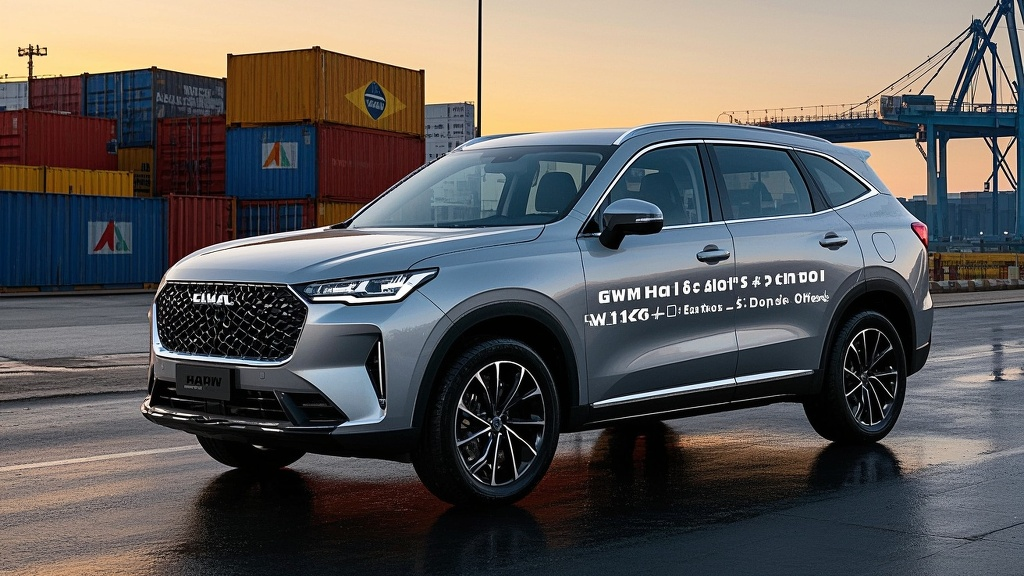
III. Price Analysis: USD $19,000–$24,000 CIF Santos Structure
The export offer is structured on CIF Santos terms at USD $19,000–$24,000. Under CIF, the seller covers ocean freight and marine insurance to the Port of Santos; the buyer handles import clearance, duties, and inland distribution. Breaking down typical components:
- Ex-Works/FOB Benchmark: Often USD $17,000–$21,500 depending on trim, safety package, and optional infotainment.
- Ocean Freight & Marine Insurance: USD $1,200–$2,000 per unit on Ro-Ro lanes (volume dependent); insurance commonly 0.5–1.0% of CIF value.
- CIF Arrives at Santos: USD $19,000–$24,000, consistent with volume tiers and sailing schedules.
Brazil import cost stack is inherently layered. While exact numbers vary by engine specification and state tax regimes, market practice references these items for complete vehicles:
- Import Duty (II): Commonly in the range up to 35% ad valorem on the customs value base.
- IPI (Excise Tax): Tiered by engine displacement; mid-size SUVs often in the low-to-mid teens percentage bracket.
- PIS/COFINS (on imports): Effective combined rates often in the low double digits, applied on defined bases that can include CIF plus II/other add-ons.
- ICMS (State VAT-like): São Paulo typical range 12–18%; base formula is cumulative and varies by product classification and local rules.
- AFRMM (Freight Surcharge): 40% applied to the ocean freight component; relevant for landed cost planning.
- Port, handling, broker, and SISCOMEX fees: Material but case-specific; budget per-unit allocations in the low hundreds of USD, subject to volume and service contracts.
Illustrative scenario (not a final quote): assuming CIF = USD $21,500, freight portion USD $1,500, duty midpoint scenario, and moderate IPI tier, a landed-cost build-up may align in the broad range of USD $28,000–$34,000 before dealer margin, depending on tax bases, credits, and state specifics. Professional brokerage is mandatory because Brazil’s tax bases cascade and incentives may apply differently per importer profile. Distributors should model three scenarios—conservative, base case, and optimized—to fix retail positioning and finance terms.
IV. Logistics and Supply Chain: Guangzhou to Port of Santos (São Paulo)
Origin is Guangzhou, leveraging Nansha or nearby South China hubs for Ro-Ro departure. Standard route planning uses transshipment via Singapore or direct sailings when available, with typical transit time 25–35 days.
- Pre-Export Steps (Guangzhou): Specification lock, QC, VIN audit, export documentation (commercial invoice, packing list, certificate of origin), and optional pre-shipment inspection. Handling time: ~7 days from readiness to onboard.
- Booking & Port Ops: Ro-Ro stow planning or container option for CKD/spares. Hazard declarations not applicable for standard vehicles; ensure battery SOH logs if hybrid/HEV variants.
- Sea Leg: South China to Santos via major transshipment nodes. Carrier choice effects transit consistency and AFRMM base (linked to freight cost).
- Arrival at Santos: Discharge, AFRMM settlement, customs clearance, SISCOMEX procedures, and tax assessment. Homologation alignment with Brazilian standards (lighting, emissions, safety compliance) coordinated pre-arrival to shorten dwell.
- PDI & Distribution: At bonded facility or partner yard; software updates and final checks before state-level distribution.
Risk controls: fix sailing windows to match Brazil’s seasonal demand (Q2–Q4). Use parts pooling in São Paulo and Paraná to maintain SLA on warranty claims and reduce initial importer inventory exposure. Leverage carrier reliability indices to mitigate rollover risk during peak season.
V. Cooperation Models and Suggestions
For Haval H6 (2025) into Brazil, we recommend structured cooperation frameworks:
- CIF Export (Wholesale): Seller covers sea freight and insurance to Santos; buyer obtains import license (LI), handles taxes and distribution. Suitable for state-level dealers scaling volume.
- Distributor Program: One or two master distributors with state exclusivity, committing to quarterly volume and parts stocking ratios; marketing support aligned with safety/utility messaging rather than pure price.
- Fleet Bundles: Ride-hailing and corporate fleets with fixed maintenance packages, ADAS training, and downtime guarantees.
- Technical Enablement: Service training at Guangzhou base or via remote modules; initial spares kit and diagnostic tools shipped alongside first batch.
Prospective partners are encouraged to visit Guangzhou to validate supply continuity, audit QC processes, and agree on trim hierarchies aligned to Brazilian tax brackets and retail positioning.
VI. Closing Note: Supply Chain Stability and Platform Credibility
Guangzhou’s export ecosystem combines predictable production slots, carrier capacity depth, and documentation reliability. For the Haval H6 (2025), this translates into consistent ETDs, limited dwell, and measurable logistics KPIs. With a disciplined CIF framework and transparent TCO modeling, Brazilian distributors can anchor pricing while preserving margins. The platform’s credibility rests on repeatable cycles: standardized specs, spare parts planning, and after-sales support that match volume ambitions rather than headline launches.
Contact us or visit our Guangzhou export base.
VII. Frequently Asked Questions
- Q: What is the typical lead time from PO to arrival at Santos?
A: 7–10 days handling to vessel, plus 25–35 days sea transit. End-to-end planning of 5–8 weeks is realistic, contingent on sailing schedules. - Q: Can we get support on homologation and documentation?
A: Yes. We coordinate with Brazilian brokers for LI, SISCOMEX clearance, and alignment with safety/emissions standards. Pre-shipment documentation packs reduce clearance times. - Q: What payment terms are available?
A: For wholesale CIF, irrevocable LC at sight or staged T/T for repeat buyers. Volume-based rebates can be set quarterly. - Q: How are spare parts and warranty managed?
A: Initial parts kits ship with first batches. Warranty policies can be tailored to fleet vs retail; SLA targets agreed per distributor. - Q: Is Ro-Ro mandatory, or can we containerize?
A: Complete vehicles favor Ro-Ro for cost and handling efficiency. Containerization is feasible for CKD kits or special circumstances, but typically not preferred for finished SUVs.
For more information, you can contact us. jiasou666@gmail.com
相关文章