MG Motor ZS 2025 Mexico Market Outlook via Veracruz Port
MG Motor ZS 2025 Mexico Market Outlook via Veracruz Port
中文译名:名爵 ZS 2025(墨西哥市场)
The MG Motor ZS 2025 aligns closely with Mexico’s fast-growing B-SUV segment, where urban buyers prioritize value, fuel efficiency, and dependable daily usability. Demand has shifted from compact sedans to small crossovers, and the ZS sits in the sweet spot: accessible retail pricing, high perceived quality, and a mature Chinese supply chain behind it. The model’s price band of MXN 340,000–470,000 retail MSRP in Mexico suggests the product can compete across entry-to-mid trims, addressing city commuting, family needs, and rideshare fleets. The question for dealers is not whether compact crossovers will keep expanding, but which platforms will deliver consistent margin and predictable lead time—ZS 2025 is structured to do exactly that.
Introduction: Mexico demand trend for MG Motor ZS 2025

Mexico’s light-vehicle market has stabilized post-pandemic with incremental recovery in retail registrations and tighter discipline on inventory. B-SUVs are taking share from both A/B hatchbacks and compact sedans. Buyers evaluate total cost of ownership—including fuel, scheduled maintenance, tire and brake wear—more rigorously than five years ago. As import channels for Chinese brands mature, shorter lead times and transparent CIF (Cost, Insurance, and Freight) models create a level playing field against regional incumbents. MG Motor’s ZS has built a reputation for straightforward specs and competitive warranty, and 2025 trims extend that positioning with a familiar footprint, practical interior, and enhancements in infotainment.
I. Market Overview: local characteristics and trend of Chinese vehicle imports
Mexico’s retail structure features a mix of legacy franchises and emerging multi-brand outlets. For B-SUVs, monthly shopper interest is concentrated in vehicles with balanced size (sub-4.4m length), efficient 1.5–1.3T powertrains, and list prices below premium thresholds to avoid steep new-vehicle taxes. Financing penetration remains essential; value retention and parts availability are top-of-mind.
The import trend from China reflects three realities: supply reliability, competitive CIF costs, and rapid homologation cycles. Ro-Ro capacity to the Gulf and Pacific has improved, and Mexican ports such as Veracruz have scaled handling efficiency for passenger vehicles. Dealers increasingly favor predictable booking windows and consistent parts pipelines over aggressive launch discounts. In this context, models like MG ZS leverage integrated supplier ecosystems in Guangzhou and the Greater Bay Area, reducing variance in build slots and accessory kits.
From a channel perspective, retail buyers in Mexico display strong interest in “value-plus” propositions. A crossover that delivers durable interiors, efficient drivetrains, and straightforward infotainment—without layering expensive options—performs well in repeat sales. The ZS 2025 aims at this median, aided by China-side QA that has become pragmatic and process-driven rather than headline-driven.
II. Model Highlights: features fit for Mexico’s use cases
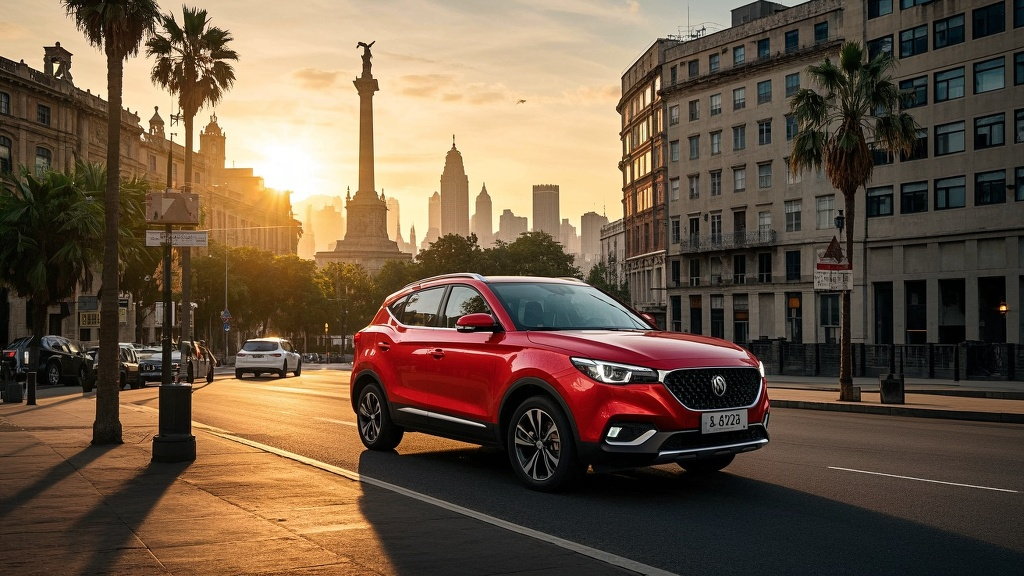
The MG Motor ZS 2025 targets the daily-driver needs of urban and suburban Mexico, from Mexico City to Puebla, Veracruz, and Guadalajara. The focus: fuel economy, usable space for family errands, pricing that fits mainstream financing, and durability in mixed road conditions. The below indicators are indicative, based on typical configurations in the segment; final specs depend on trim and homologation release.
| Feature | MG ZS 2025 (Indicative) | Local Relevance |
|---|---|---|
| Fuel Efficiency | ~6.8–7.6 L/100 km combined (NA 1.5L or small turbo) | Addresses urban stop-go driving and rideshare TCO |
| Cabin & Cargo Space | 2-row, ~430–450 L trunk, flat-fold rear seats | Weekend family trips, city errands; optimal B-SUV footprint |
| Price Positioning | MSRP: MXN 340,000–470,000 range | Competitive financing, accessible monthly payments |
| Durability & Service | Robust suspension tune, common-wear parts readily available | Adaptable to mixed road conditions; predictable maintenance |
Infotainment packages typically include smartphone integration and driver-assist basics. The brand’s approach is pragmatic: offer essential features in base trims and keep optional add-ons rational to avoid price creep. This plays well in Mexico’s value-sensitive retail front.
III. Price Analysis: MSRP band, export pricing logic, CIF and duty references
Retail MSRP in Mexico is indicated at MXN 340,000–470,000, placing ZS in the mainstream B-SUV corridor. Retail pricing structures typically reflect distribution margin, taxes, logistics, and warranty reserve. Dealers operating in Mexico pay close attention to CIF build-ups and duty exposure; small variances can compress monthly payment affordability.
Indicative export/CIF modeling (scenario only, for planning insight):
- Assumed EXW Guangzhou (vehicle + base accessories): USD 16,000–21,000 per unit depending on trim.
- Ocean Freight & Insurance to Veracruz Port (Ro-Ro): ~USD 1,100–1,400 per unit, subject to seasonality and carrier scheduling.
- Port Handling & Local Logistics (Veracruz landing + pre-delivery transport): ~USD 300–600 per unit.
- CIF Veracruz: EXW + Freight + Insurance, often USD 17,400–22,400 before duties and taxes.
Duty and tax references (consult current law and broker guidance): Mexico applies IVA (VAT) at 16% on customs value plus duty; new-vehicle tax (ISAN) applies progressively by vehicle price bracket; ecological or local levies may apply in certain jurisdictions. As an illustrative modeling assumption only (not legal advice), using a 15% import duty for non-FTA origin passenger vehicles provides a baseline for dealer feasibility studies. The real duty can differ—brokers should confirm HS code specifics, origin rules, and any tariff updates.
Conversion to MSRP: Starting with CIF, add duty (if applicable), 16% VAT on the adjusted taxable base, ISAN per bracket, inland distribution, PDI, retail margin, and financing cost. In practice, the resulting retail window often correlates with MXN 340,000–470,000 for ZS trims, assuming stable FX and disciplined margin targets. If FX volatility widens, dealers may opt for staged price protection or hedge small fractions of inventory exposure for peak arrival months.
Is CIF compression realistic without eroding warranty reserves? Yes, if carriers maintain schedule reliability and China-side consolidation stays efficient. Dealers can also optimize accessories bundling at the Guangzhou side to avoid duplicated local fitment costs that inflate the final sticker.
IV. Logistics & Supply Chain: from Guangzhou to Veracruz Port
The Guangzhou-to-Veracruz pathway consolidates at export yards near the Guangzhou Export Zone. The preferred method is Ro-Ro, given vehicle integrity and load/unload speed. Containerized options exist for mixed shipments or specific trim protection, but Ro-Ro remains cost-effective for standardized batches.
- Pre-Export Prep: Quality inspection, PDI baseline, documentation, and optional third-party verification. VIN-level records and accessory reconciliation are performed before port dispatch.
- Booking & Scheduling: Space booking with major Ro-Ro carriers; typical sailing windows align with 25–35-day ocean transit, reflecting the route via the Pacific and Panama Canal to the Gulf, final call at Veracruz.
- Transit & Insurance: Marine insurance on agreed terms; monitoring of vessel ETD/ETA to plan customs broker and inland logistics.
- Arrival & Clearance: Veracruz Port handling, customs clearance with validated documentation, duty/tax settlement, and trucking to dealer hubs or regional PDI centers.
- Post-Arrival PDI: Final checks, software updates, and local accessory fitment; synchronization with sales campaigns and financing approvals.
Lead time overview: 7 days handling before sailing, 25–35 days at sea, 3–6 days clearance and inland transport. Dealers who align marketing calendars with vessel ETAs reduce idle inventory costs and protect gross margin.
V. Cooperation Models & Suggestions
Dealers in Mexico seeking stability favor transparent terms and pilot batches. Suggested collaboration approaches:
- Pilot Lot & Feedback Loop: Start with 20–50 units across key trims. Use a 90-day feedback loop for sales velocity, PDI observations, and customer service signals.
- Accessory Strategy: Bundle high-demand accessories at origin to avoid duplicated local labor. Standardize floor mats, dash cams (where permitted), and protective films with controlled warranty impact.
- Homologation & Compliance: Align with Mexican NOM requirements and applicable safety standards. Expedite paperwork and ensure labels, manuals, and software localization are consistent.
- Warranty & Parts: Lock in parts SKUs and reorder triggers before retail launch; partner on technician training with measured KPIs—first-fix rates and turnaround time.
- Visit & Audit: Invite dealer principals and operations leads to Guangzhou for process audits, vendor meetings, and real-time slot reservation.
Why propose a Guangzhou visit? Observing supplier stability, accessory prep, and yard discipline reduces perceived risk and builds confidence in delivery integrity. It also shortens the learning curve for teams new to Chinese-origin supply chains.
VI. Conclusion: supply chain stability and platform credibility
ZS 2025’s appeal in Mexico is not only product fit; it is the coherence of the upstream process—parts integration, QA checkpoints, and predictable Ro-Ro bookings. A stable China-side pipeline translates into reliable CIF and fewer retail surprises. For dealers, trust in delivery timetables and parts availability drives repeat sales more than headline launch discounts. The MG Motor ZS 2025 leverages the mature industrial ecosystem in Guangzhou to make this predictability tangible.
In an environment where the cost of capital and FX swings influence monthly targets, platforms that provide transparent cost structures and consistent lead times become competitive advantages in themselves. The proposition here is straightforward: measurable cost, measurable time, measurable quality.
VII. FAQs
- Q: What is the typical lead time from PO to delivery at Veracruz?
A: Planning for 7 days handling, 25–35 days ocean transit, and 3–6 days clearance/inland logistics is realistic. Peak season may add variance. - Q: How is warranty handled in Mexico retail?
A: Warranty policies can be aligned with local dealer networks; recommended to maintain centralized parts stocking and technician training to ensure first-fix rates. Terms depend on final distributor agreements. - Q: Are Mexican homologation requirements complex for ZS 2025?
A: Compliance is manageable if documentation, labeling, and safety requirements under Mexico’s applicable NOM standards are prepared early. A consolidated compliance checklist reduces delay risk. - Q: What payment terms are feasible for pilot lots?
A: Structured deposits with balance against BL (Bill of Lading) or upon landing are common. Terms depend on risk assessment, credit history, and inventory size. - Q: Can accessories be installed in Mexico instead of Guangzhou?
A: Yes, but cost control is stronger when standardized kits are fitted at origin with QA sign-off. Hybrid models are possible for items best handled locally.
Contact us or visit our Guangzhou export base.
For more information, you can contact us. jiasou666@gmail.com
相关文章